
Everything YOU need to know about competing in the California Tricking Championship 2026 Season. Divisions, formats, points and more!
The California Tricking Championship is a season-long competitive league designed to showcase the best tricking talent across the state — while staying true to the open, community-driven roots of the sport.
CATC events are structured around open competition. No qualifications are required to enter any event. All athletes are welcome to compete at Regionals and State competitions, regardless of experience, ranking, or prior results.
Rather than restricting entry, CTC uses its event structure to award points and track season performance.
Each competitive event consists of two phases - The Preliminaries and the Bracket Battle.
Format:
Each competitor performs 2 individual passes. There are no limits on a pass length.
Seeding
After all preliminaries are complete, competitors are ranked from highest to lowest based on a seeded score by a panel of judges. Judging panel will vary from 3 to 5 individual judges.
Division Brackets:
Competitors are broken up into multiple single-elimination brackets based on their seeding in the Preliminaries. Regional Competitions are brackets of 4. State Competitions are brackets of 8.
| Total Number of Athletes | Division Bracket |
|---|---|
| 2-5 | D1: 1-4 +1 |
| 6-9 | D2: 5-9 +1 |
| 10-13 | D3: 9-12 +1 |
| Total Number of Athletes | Division Bracket |
|---|---|
| 2-9 | D1: 1-8 +1 |
| 10-17 | D2: 9-16 +1 |
| 18-25 | D3: 17-24 +1 |
All Division Bracket winners will receive points appropriate to their level. Each Division Bracket is indicative of the individual event - not the overall season placement.
Bracket Battle Format:
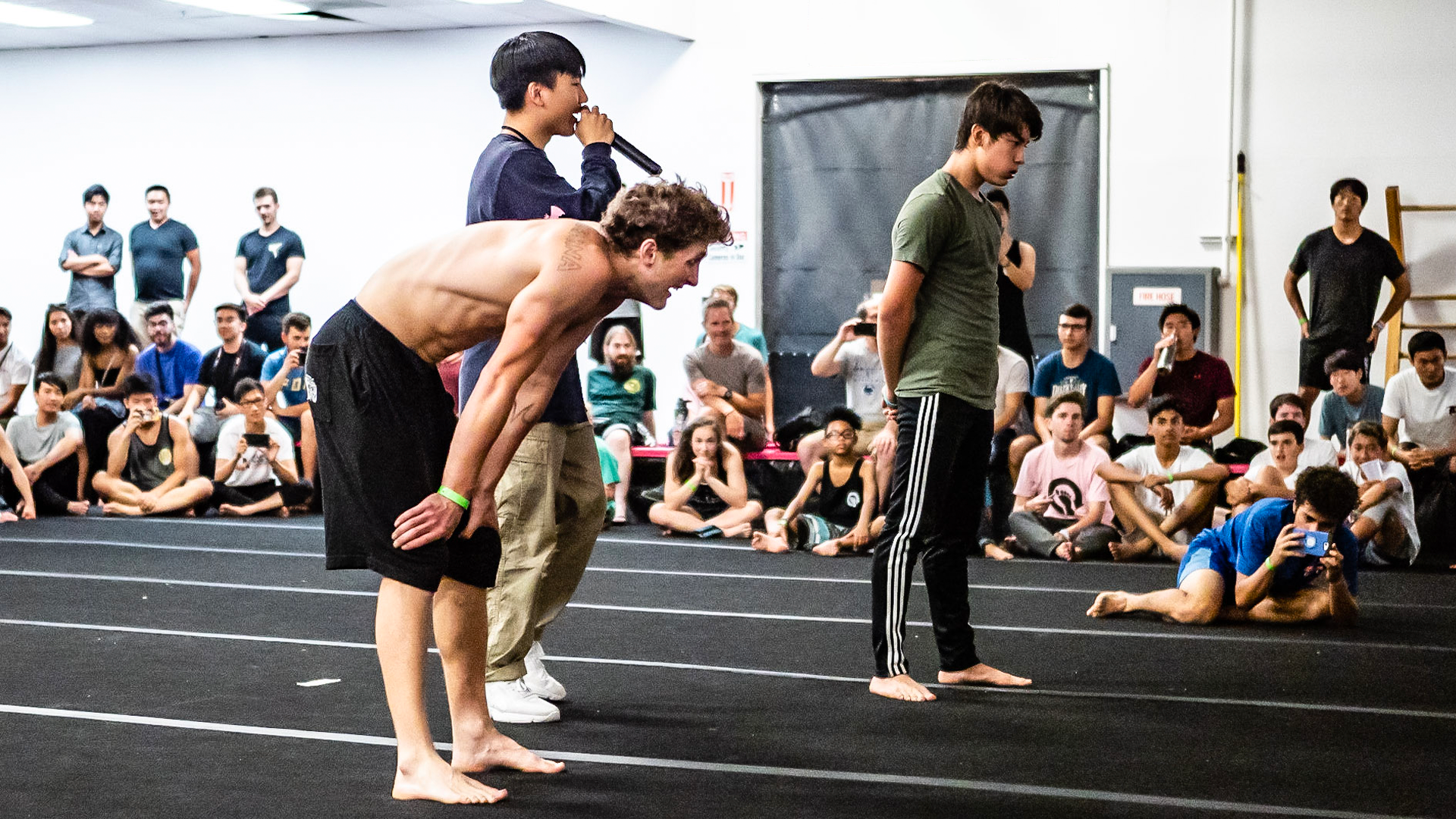
Battles follow a best-of-three rounds format. Each round will consist of two passes, one from each athlete. A 45-second rest timer will be started before each pass. The athlete must start their trick pass before the timer is up, otherwise they forfeit their pass. Judges will evaluate at the end of each round. First athlete to win two rounds advances. The athlete with the better seed decides the battle order.
Preliminaries and Bracket Battles will be judged on the following criteria: difficulty, execution, and battle presence. Each judge will evaluate on all three categories holistically and consider both the technical ability and performance quality of each pass.
Difficulty
Difficulty measures the technical challenge of the tricks being performed. This includes (but is not limited to):
- Number of Flips
- Number of Twists
- Number of Variations
- Transition Variety
- Landing Stances Variety
- Combo Creativity
Execution
Execution is defined by how each trick and combo is performed. This includes (but is not limited to):
- Kick Height / Extension
- Variation Definition
- Proper Rotation
- Landing Quality
- Combo Flow
- Speed and Tempo
Battle Presence
Battle Presence refers to an athlete’s overall performance and impact during a battle. This includes confidence, energy, and how effectively an athlete responds to their opponent. Battle Presence is inherently subjective and is evaluated based on the judges’ overall impression of how an athlete carries themselves and performs throughout the battle.
Youth Category (17 and under only)
Open Category (All ages allowed)
When you enter the season, you'll select your age group based on age as of February 21, 2026. Even if you have a birthday later in the season, you can stay in the same age group for the entire rest of the season.
Youth competitors ages 17 and under can elect to compete in the Open Category. If a youth competitor switches to the Open Category mid-season (or vice-versa), their season points will only count towards each respective category they competed in.
Points are awarded according to tier of event (Regional/States) and division.
| Overall Placement | Division Placement | Points |
|---|---|---|
| 1 | D1 1st | 50 |
| 2 | D1 2nd | 44 |
| 3 | D1 3rd | 39 |
| 4 | D1 4th | 35 (33*) |
| 5 | D2 1st | 34 |
| 6 | D2 2nd | 30 |
| 7 | D2 3rd | 26 |
| 8 | D2 4th | 22 (20*) |
| 9 | D3 1st | 21 |
| 10 | D3 2nd | 18 |
| 11 | D3 3rd | 15 |
| 12 | D3 4th | 12 (10*) |
| 13 | D4 1st | 11 |
| 14 | D4 2nd | 9 |
| 15 | D4 3rd | 7 |
| 16 | D4 4th | 5 (4*) |
| 17 | D5+ 1st | 4 |
| 18 | D5+ 2nd | 4 |
| 19 | D5+ 3rd | 4 |
| 20 | D5+ 4th | 4 |
| Overall Placement | Division Placement | Points |
|---|---|---|
| 1 | D1 1st | 75 |
| 2 | D1 2nd | 66 |
| 3 | D1 3rd | 60 |
| 4 | D1 4th | 55 (52*) |
| 5 | D2 1st | 51 |
| 6 | D2 2nd | 45 |
| 7 | D2 3rd | 39 |
| 8 | D2 4th | 35 (33*) |
| 9 | D3 1st | 32 |
| 10 | D3 2nd | 27 |
| 11 | D3 3rd | 23 |
| 12 | D3 4th | 24 (20*) |
| 13 | D4 1st | 17 |
| 14 | D4 2nd | 14 |
| 15 | D4 3rd | 11 |
| 16 | D4 4th | 10 (8*) |
| 17 | D5+ 1st | 6 |
| 18 | D5+ 2nd | 6 |
| 19 | D5+ 3rd | 6 |
| 20 | D5+ 4th | 6 |
All athletes are expected to conduct themselves with professionalism, respect, and integrity throughout the event. Participation in this competition implies agreement to the following code of conduct.
1. Sportsmanship and Respect
Athletes must demonstrate good sportsmanship towards judges, opponents, staff, and spectators. Unsportsmanlike behavior may result in warnings, penalties, or disqualification.
2. No Physical Contact
Tricking is a non-contact competition. No pushing, shoving, blocking, or physical intimidation and accidental contact should be avoided whenever possible. Any intentional physical contact toward another athlete, judge, or staff member may result in immediate disqualification.